Tower Rush asks one thing of you, over and over: stop now, or add another floor? Everything else in Tower Rush hangs on that choice, and our aim here is to make the game clear before any money goes in.
You start each round with bare ground and a stake. Floors stack up, the multiplier climbs with them, and at some unknown point the structure gives way. Get out in time and your bet returns multiplied by whatever value is showing. Stay too long and the round is gone.
Simple to describe, harder to play well.
Below, you will find a plain account of the rules, from the first floor to the final cash-out or collapse. We cover the two ways to collect, the trio of unusual floors a round may produce, the published return-to-player range and the stake limits. Further down you will also find notes on free play, on mobile devices, and on finding a licensed casino if you later decide to play with real money.
The page also spends time on the less exciting material: budgets, breaks, and the honest limits of any approach to a random game. Skip it if you like, but it is probably the most useful part.
About the Tower Rush site
Treat what follows as a practical reference on the game, not a pitch. Everything here is built around one question: what actually happens when you play?
The order follows a first session. You start with the concept and the developer, move on to how a round unfolds, then learn the two ways of collecting. After that come the special floors, the figures behind the game, and the practical side: free play, mobile play and real-money play.
The last third turns to habits. Fast rounds can eat time and money without you noticing, so the responsible play section is written as a checklist you can return to.
A short set of answers closes the page. Those answers pick up details the main sections leave aside, so they are worth a glance even if you read everything else.
One thing the site does not do is predict outcomes, sell signals or claim a winning system. No such thing exists for this game, and you will see why further down.
What Tower Rush is
Behind the building theme, Tower Rush counts as a crash title, played in short instant rounds. Galaxsys developed it and brought it out in 2026, placing it among those crash games where a number keeps growing and your job is to get out before the round ends.
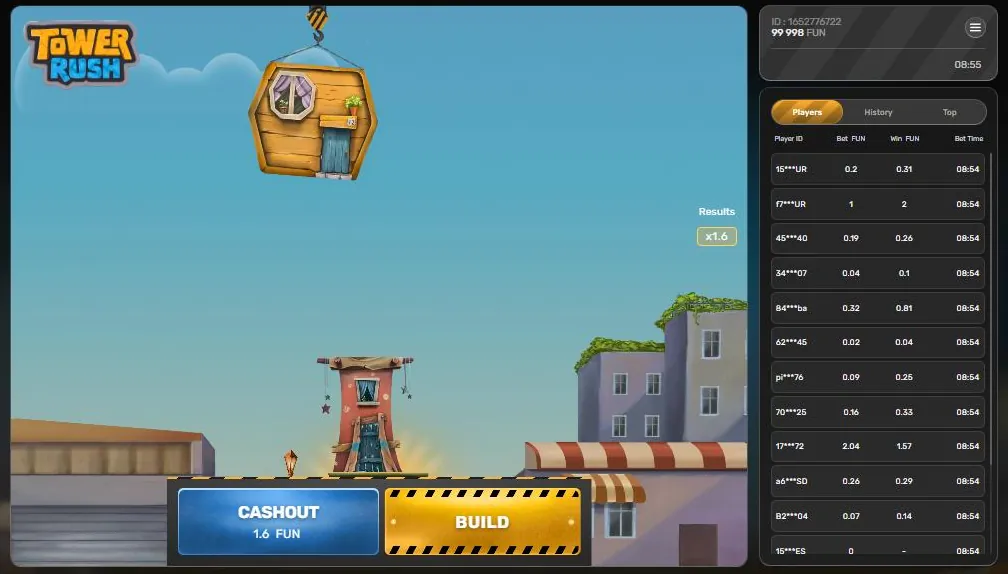
The twist is visual and easy to follow. Rather than a curve climbing across a chart, you see a building rise storey by storey. Every added level raises the multiplier. Every added level brings danger as well, since a taller stack is likelier to topple on the following placement.
That trade-off is the entire design. Forget reels, paylines or matching symbols; that absence alone is what distinguishes it from slot machines. A slot spins and settles on a result by itself. Here the result depends on when you, the player, choose to stop.
Rounds are short. You can play dozens in a session, which is part of the appeal and part of the risk.
Galaxsys builds the game, yet running the casinos that host it is someone else's business. Operators license the title and install it on their platforms, sometimes in slightly different versions. That detail matters later, when we get to the return-to-player figures.
How a Tower Rush round works
Here is a full round, step by step, from the moment you choose your bet to the moment it ends.
Pick your stake. Your casino's configuration sets the range, with €0.1 as the floor and €100 as the ceiling. Choose an amount that fits comfortably inside the budget you set for the whole session, not just this one round. Choose your exit method. Should you prefer an automatic collection, choose the multiplier you want before play starts. Otherwise the exit stays in your hands. Start the round. The plot is empty, with no floors standing and the multiplier at its opening value. Watch the floors go up. With each added storey, the multiplier creeps up. It also raises the risk that the following floor will be the one that brings everything down. Look out for special floors. During some rounds, a special floor may appear, namely Temple Floor, Triple Build or Frozen Floor. Each changes what happens next, and each has its own section below. Decide when to collect. Cashing out is possible at every point up to a collapse. You receive your bet times the multiplier on screen at that instant. Or watch it fall. Should the tower crumble first, you lose that round's bet in full, with nothing handed back.
A quick illustration helps here, and it is only that. Suppose €2 goes in and you collect at x3.50. You get €7 back. The point is purely the arithmetic. No floor is linked to that value, and it gives no hint of how often Tower Rush rounds get that far.
Notice what the steps leave out. There is no moment where skill changes the odds of a collapse. Your only lever is timing, and timing cannot see the future.
Cashing out by hand or automatically
You have two ways to leave a round with your winnings. Neither one is better in itself; they suit different temperaments.
Manual cash-out
Manual play means you watch and decide. The floors rise, the multiplier ticks up, and you choose the instant you have seen enough.
The appeal is flexibility. You can react to the feel of a session, take a small profit early, or let a promising round run a little longer.
The weakness is you. Quick rounds encourage quick decisions, and a moment of hesitation can cost a round that was already in profit. Greed works against you too: a multiplier that looked generous a few seconds ago can start to seem too small just before the fall.
Auto cash-out
Auto cash-out takes the decision away from the heat of the moment. Your chosen multiplier is fixed beforehand. Once the tower gets there, your winnings are taken off the table without you lifting a finger.
This suits anyone who wants consistency. You decide calmly in advance, and the round plays out without second-guessing.
Remember that a target is not a guarantee. A collapse that arrives before your target still costs the full stake, just as it does when you play by hand. Choosing a lower target means collecting more often but smaller amounts; a higher one means rarer, larger returns.
The three bonus floors in Tower Rush
An ordinary floor does two things: it adds height and nudges the multiplier upward. Three floors in Tower Rush break that routine. Triple Build, Temple Floor or Frozen Floor may arrive partway through, and each one alters the usual course of play.
There is no way to call them up, nor any warning before one arrives. They are part of the random outcome of each round, like the collapse itself.
Precise behaviour, plus any numbers linked to these floors, can be found in the rules bundled with whichever version you load. We describe what each one does in principle and leave the numbers to the game's own rules, since they can differ by version.
Frozen Floor
Frozen Floor is the safety net among the three. Its job is to secure what you have won up to the level it occupies.
In practice, that changes how a round feels. Before the freeze, everything you have built is at risk. Once the frozen level is in place, the amount reached there is locked in rather than left hanging on the next floor.
It is worth reading the rules carefully on one point: Frozen Floor protects what you have earned at that height. The rest of the climb stays as risky as before, and the call on when to collect is still yours.
Temple Floor
Temple Floor is one of two specials that reshape how the multiplier progresses. Instead of rising in the usual step-by-step fashion, the multiplier follows its own behaviour while this floor is in play.
We give no values here, deliberately. How Temple Floor shifts the multiplier is explained inside the game's own rules, and nothing else is a dependable reference. If you see a figure quoted somewhere else, check it against the version you are actually playing.
Triple Build
Triple Build also carries its own multiplier behaviour. When it turns up, the round stops moving the way ordinary floors make it move.
Here too, the specifics for Tower Rush sit in each version's rule sheet. A round that includes Triple Build still ends the same two ways as any other: you collect, or the structure comes down first.
RTP and stakes
The figures that matter most before you play are gathered below. One is a band, one depends on the operator, and two are left to each version's own rules.
| Item | Detail |
|---|---|
| RTP range | Galaxsys gives 96.25% as the low point and 97.5% as the high point; the precise value follows whichever version is installed |
| Stakes | Minimum €0.1, maximum €100 a round, subject to each casino's settings |
| Volatility | Given in each version's own rules |
| Maximum win | Found, with the top multiplier, in each version's own rules |
RTP, meaning return to player, is a long-term average spread over a vast number of rounds. It says nothing reliable about a single evening, and your own result may finish well over or well under it.
Because the range is wide enough to matter, the sensible habit is to open the rules of the game before your first round at any casino. Those rules show the RTP for the version installed there. The volatility rating sits there too, alongside the ceiling on the multiplier and on any payout. We quote none of them, because each belongs to a particular version, not to Tower Rush in general.
The same advice covers stakes. A casino may narrow the bet limits inside the published band, so one site's bet range may differ from another's.
If you are using a casino bonus, read its terms too. Each operator decides how far crash games contribute to wagering, which games it leaves out, and how large a single bet may be while bonus money is in play.
Playing the Tower Rush demo
Trying the game for nothing is the gentlest introduction to Tower Rush. The balance consists of virtual credits, which means every gain and every loss is worthless in cash terms. Plenty of casino sites carry it, and so does our page.
Demo mode follows the same rules as the real-money game. Floors rise, special floors can appear, and a collapse may strike at any height, exactly as in paid rounds. What disappears is the consequence.
Use that freedom well. Try manual cash-out for a while, then switch to auto cash-out and compare how each one suits you. Notice how often rounds end early, and how far others manage to go. Get a feel for the speed of play before money is involved.
Availability varies. Not every casino offers free play on every title. If the demo is missing on one site, another may carry it.
One caution: results in demo mode are no more predictive than results with real money. A lucky streak with play money predicts nothing for later.
Playing on phones and tablets
You do not need to install anything to play Tower Rush. A phone or tablet browser is enough, and a desktop computer works just as well.
Ce point mérite d'être souligné en raison de ce qui circule en ligne. Tout fichier proposé comme application ou APK pour le jeu, en particulier ceux promettant des prévisions ou un avantage, doit être considéré comme suspect. Le véritable jeu n'a pas besoin de téléchargement, donc ces fichiers n'ont aucune utilité réelle et peuvent cacher des logiciels malveillants.
Les petits écrans soulèvent quelques préoccupations pratiques. Une connexion stable est primordiale, car perdre le signal en plein milieu d'une partie rapide est frustrant.
Le jeu mobile est également l'endroit où les sessions s'étirent le plus longtemps sans que personne ne s'en rende compte. Un jeu qui tient dans une poche rentre dans les minutes d'inactivité toute la journée. Si cela vous semble familier, les limites décrites plus loin sont encore plus importantes.
Où jouer pour de l'argent réel
Jouer à Tower Rush pour de l'argent n'est possible qu'à un casino en ligne licencié dont le catalogue inclut les titres de Galaxsys. Les joueurs doivent avoir au moins 18 ans.
Il est utile de garder les rôles clairs. Galaxsys s'occupe du développement. Le casino détient la licence, gère votre compte, prend vos dépôts et paye vos gains. Si vous avez une question concernant un paiement ou une limite, c'est le casino que vous devez contacter, pas le studio.
Avant de vous inscrire quelque part, vérifiez trois choses : qu'une licence valide est clairement affichée, qu'il est permis d'offrir des jeux là où vous vivez, et que la fourchette de paris proposée sur ce jeu correspond à votre budget.
Le chemin habituel est simple. Vous vous inscrivez au casino licencié, vérifiez votre identité comme requis, financez le compte, puis allez dans la catégorie des titres crash et instantanés pour le trouver.
Méfiez-vous des sites sans licence visible, des canaux vendant des signaux ou des prévisions, et des bots qui prétendent lire l'effondrement suivant. Le hasard gouverne chaque ronde, donc tout ce qu'ils vendent ne peut pas délivrer ce qu'il prétend.
Jouer à Tower Rush de manière responsable
La vitesse du jeu est son principal risque. Les rondes se terminent en quelques secondes, et l'envie de recommencer arrive tout aussi vite. Ces habitudes aident à garder le jeu sous contrôle :
Fixez un budget avant votre première ronde, et considérez cette somme comme déjà dépensée. Déterminez combien de temps vous allez jouer, et arrêtez-vous quand ce temps est écoulé, peu importe ce que montre votre solde. Gardez chaque mise petite par rapport à votre budget total, afin qu'une série d'effondrements précoces ne mette pas fin à la session en quelques minutes. Activez toutes les limites de dépôt et de temps que votre casino propose. Elles fonctionnent mieux lorsqu'elles sont réglées un jour calme, pas à mi-chemin d'une série de pertes. Prenez des pauses régulières. Même une courte pause interrompt rapidement le rythme que créent les jeux rapides. Ne poursuivez jamais les pertes. Des mises plus importantes visant à récupérer les pertes tendent à aggraver la situation. Évitez de jouer lorsque vous êtes fatigué, contrarié ou après avoir bu, car les décisions rapides sont les premières à en pâtir. Envisagez l'auto-exclusion si vous souhaitez une pause plus longue ; demandez à votre casino ce qu'il propose. Lorsque jouer ne devient plus agréable, contactez une organisation d'aide professionnelle sans attendre. Un contact précoce tend à faciliter le soutien. Ce qu'il faut garder à l'esprit
Certaines choses sont mieux dites sans embellissements. Votre taux de retour dans Tower Rush est lié à la version choisie par un opérateur, donc consultez-le dans les règles. Un effondrement vous coûte la mise de cette ronde, à chaque fois, sans exception. Cette page ne mentionne ni la volatilité ni le gain maximum ; vous devez les lire dans les règles pour la copie du jeu que vous ouvrez.
Chaque ronde de Tower Rush est indépendante, avec un résultat aléatoire. Une longue série d'effondrements précoces ne rend pas une haute tour plus probable la prochaine fois, et une série de rondes élevées ne signifie pas qu'une chute est imminente. Aucun modèle ne prédit quand la structure s'effondrera, et aucune méthode d'aucune sorte ne peut promettre un résultat gagnant. Jouez pour le divertissement, avec de l'argent mis de côté pour cela, et le jeu reste un passe-temps plutôt qu'un problème.